
As New Delhi prepares to host the fourth edition of the India-Africa Forum Summit (IAFS-IV) later this month, India and Africa stand at an important moment in their shared journey. Convened under the theme “IA SPIRIT: India-Africa Strategic Partnership for Innovation, Resilience and Inclusive Transformation”, the Summit reflects a partnership anchored in solidarity, mutual respect, and a common vision for the future.
The India-Africa relationship is not a recent construct of diplomacy. It is a civilisational bond forged over centuries through trade, cultural exchanges, and people-to-people interactions across the Indian Ocean. These historic links acquired renewed meaning during the anti-colonial era, when India stood shoulder to shoulder with African nations in their struggle for freedom, dignity, and self-determination.
Today, Africa occupies a central place in India’s foreign policy and strategic outlook. India’s Viksit Bharat 2047 vision and Africa’s Agenda 2063 roadmap are naturally complementary, both seeking sustainable growth, inclusive development, and greater voice for the Global South in international affairs.
The intensity of India-Africa engagement in recent years reflects sustained political commitment at the highest levels. Prime Minister Narendra Modi’s landmark address to the Ugandan Parliament in 2018 laid out the guiding principles of India’s engagement with Africa — partnership based on consultation rather than conditionalities, priorities shaped by African needs, and development driven by empowerment rather than dependency. These principles continue to guide India’s outreach across the continent.
India’s expanding diplomatic footprint is itself testimony to this commitment. Seventeen new Indian missions have been opened in Africa in recent years, taking the total number of resident Indian missions on the continent to 46.
India has also consistently advocated for Africa’s rightful place in global governance structures. This commitment was most visibly demonstrated during India’s G20 Presidency in 2023, when the African Union was admitted as a permanent member of the G20 — a historic step that ensured Africa’s voice would find permanent representation at one of the world’s most consequential economic forums.
Africa remains one of India’s most important development partners. India’s development cooperation model is distinct in being demand-driven, consultative, and aligned with the priorities of partner countries. Through concessional Lines of Credit, grant assistance, and capacity-building programmes, India has supported transformative projects across sectors ranging from infrastructure and healthcare to agriculture and education.
Equally significant has been India’s investment in human resource development. The Indian Technical and Economic Cooperation (ITEC) programme has trained thousands of African professionals in diplomacy, defence, information technology, entrepreneurship, and governance. Simultaneously, ICCR scholarships have enabled generations of African students to pursue higher education in India, creating enduring bridges between societies.
One of the most promising frontiers of India-Africa cooperation today lies in digital technology and fintech. India’s experience in developing large-scale Digital Public Infrastructure — including Aadhaar and the Unified Payments Interface (UPI) — offers scalable and affordable models for financial inclusion and digital governance. As African economies accelerate digital transformation, these experiences hold considerable relevance.
Climate change presents another major area of convergence. Africa remains among the regions most vulnerable to climate shocks, despite contributing minimally to global emissions. India’s global climate initiatives — including the International Solar Alliance, the Coalition for Disaster Resilient Infrastructure, the Global Biofuels Alliance, and the International Big Cat Alliance — have therefore found natural and enthusiastic partners across Africa.
For Mauritius, the India-Africa Forum Summit carries particular resonance. As a country where a majority of the population traces its origins to India, and as a member of the African Union, SADC, and COMESA, Mauritius is positioned at a unique strategic and cultural intersection between India and Africa.
India and Mauritius today share one of the most comprehensive bilateral partnerships in the region. This relationship was elevated to an Enhanced Strategic Partnership during Prime Minister Narendra Modi’s visit to Mauritius last year — a landmark visit that also saw the articulation of Vision MAHASAGAR (Mutual and Holistic Advancement for Security and Growth Across Regions), India’s contemporary framework for engagement with the Global South and the wider Indian Ocean region.
Mauritius has also been the site of several pioneering initiatives in India’s engagement with Africa. The Comprehensive Economic Cooperation and Partnership Agreement (CECPA), signed in 2021, was India’s first trade agreement with an African country. Mauritius was similarly the first African nation where UPI and RuPay were launched, demonstrating the growing depth of digital cooperation between the two countries.
India’s development partnership with Mauritius has consistently focused on delivering projects of direct national importance. These include the Metro Express Project, the Supreme Court Building, the ENT Hospital, social housing initiatives, the Renal Transplant Unit, MediClinics, and Area Health Centres. Several important projects are currently underway, including the Forensic Science Laboratory, the National Archives and Library, and the Mauritius Police Academy. The Special Economic Package worth USD 680 million announced last year marks another significant milestone in this evolving partnership.
Sustainability has also emerged as a key pillar of bilateral cooperation. The 8 MW Solar Power Plant, the deployment of 100 electric buses, and ongoing Floating Solar PV projects reflect a shared commitment to green growth and climate resilience. Cooperation through platforms such as the International Solar Alliance, the Global Biofuels Alliance, and the Coalition for Disaster Resilient Infrastructure further reinforces the two countries’ common commitment to sustainable development.
India’s contribution to Mauritian human capital development has likewise been longstanding. The Atal Bihari Vajpayee Institute of Public Service and Innovation, jointly inaugurated by Prime Minister Narendra Modi and Prime Minister Navinchandra Ramgoolam, stands as a symbol of this enduring partnership. Mauritius also remains among the largest beneficiaries of the ITEC programme, while 40 scholarships are awarded annually under the ICCR India-Africa Maitri Scholarship Scheme.
As the world enters a new era shaped by artificial intelligence, digital transformation, and the green economy, the Global South has an unprecedented opportunity to shape emerging global narratives and institutions. India, Mauritius, and Africa are not merely participants in this transformation — they are partners in shaping it.
The India-Africa partnership is ultimately about more than economics or geopolitics. It is about empowering people, strengthening institutions, building resilience, and creating pathways for inclusive and sustainable progress. The fourth India-Africa Forum Summit will therefore not merely review a partnership of the past; it will help define a partnership for the future.
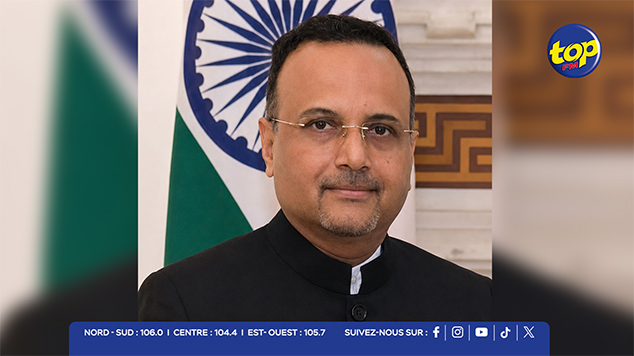
H.E. Mr. Anurag Srivastava
High Commissioner of India to Mauritius